|



Travels From:
Regional Queensland
Fee Range: E
|
|
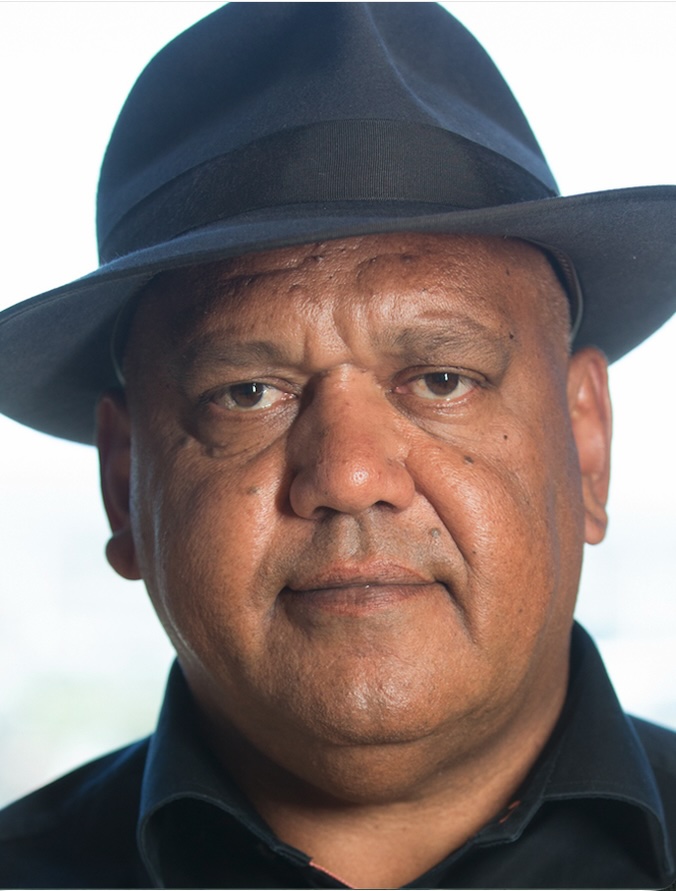
Noel Pearson was born in 1965 in Cooktown into the Baagarmuugu (Little Red Flying Fox) clan of south-eastern Cape York Peninsula, he comes from the Guugu Yimithirr community of Hope Vale where he spent his early years.
Noel completed his high school education at St Peter’s College, Brisbane, on a Lutheran scholarship, and was the first Aboriginal Cape York student to attend Sydney University, graduating in 1993 with degrees in Law and History.
As part of his studies, Noel completed an honours thesis at the University of Sydney in 1986 titled Ngamu-Ngaadyarr, Muuri-Bunggaga and Midha Mini in Guugu Yimithirr History: Hope Vale Lutheran Mission 1900–1950 — translated as “Dingoes, Sheep and Mr Muni in Guugu Yimithirr History.” The thesis explored the social, cultural, and religious dynamics of the Hope Vale community between 1900 and 1950 and drew on a series of oral history interviews Noel conducted in 1986 with older community members, including Roger Hart, to record first-hand accounts of mission life, language, and cultural change.
In 1990, while still at university, Noel co-founded the Cape York Land Council and in 1993, following the High Court of Australia’s Mabo decision, launched the Wik Native Title Claim in the Federal Court, resulting in Queensland’s first successful land claim. In that same year, he and a group of Indigenous leaders negotiated with the Keating Labor government to establish the Native Title Act, which was passed in the Senate on December 21, 1993. He was Executive Director for the Cape York Land Council until retiring from the position in 1996.
In 1995 Noel and several Cape York Indigenous leaders established an 'Indigenous Business Institute' (IBI), which later became Jawun, a non-profit organisation which manages secondments from the corporate and public sectors to a range of Aboriginal and Torres Strait Islander partner organisations across Australia. Noel also helped establish Apunipima Health Council .
At the age of 35, Noel made the decision to eschew a potential career in Federal politics believing he could work more effectively as an indigenous leader outside of the political system.
At this time, he published the paper Our Right to Take Responsibility (2000) critiquing the impact of three decades of Aboriginal policy and welfare dependence in Australia and arguing for profound structural change and new forms of Aboriginal governance to combat
the devastating effects of what he terms ‘passive welfare’.
Acting to address these issues, he founded the Cape York Institute and the Cape York Partnership (CYP) in July 2004; not-for-profit organisations dedicated to developing policy and leadership programs designed to end passive welfare and empower Cape York Indigenous residents to improve their own lives. Over time, CYP has grown into a network of organisations and enterprises, including education, employment, health, language and community initiatives such as the Cape York Employment, Bama Services, Pama Language Centre, and Mayi Market, each working toward the shared goal of enabling economic independence and local leadership across Cape York communities.
In May 2007, Noel, in his role as Director of the Cape York Institute, presented a report entitled From Hand Out to Hand Up to the Federal Government which details a series of radical recommendations for welfare reform in Cape York Indigenous communities. The report led to the implementation of the Cape York Reform Trial in 2008 which introduced
conditional welfare payments and other reforms into four Cape York communities including the establishment of The Family Responsibilities Commission (FRC).
Noel has pursued a longstanding dedication to improving education outcomes of Aboriginal and Torres Strait Islander people. He personally supported a young student, Tania Major to pursue a first-class education outside of her home community of Kowanyama Cape York. Tania was named as the Young Australian of the Year in 2007, having been earlier named as the Queensland Young Australian of the Year.
This experience inspired Pearson to establish the Cape York Leaders Program through which education and leadership development of Indigenous people from across Cape York
communities is supported. At the heart of the Cape York Leaders Program is its highly successful boarding school scholarship program, supporting students from Cape York communities to access high-quality secondary education in private boarding schools across the state. The program’s success and structure later inspired similar Indigenous leadership and mobility initiatives across Australia, including the Indigenous Youth Mobility Pathways Project (IYMP), making CYLP one of the earliest and most influential models of its kind.
Tackling the issue of education, his Quarterly Essay: Radical hope – Education and equality in Australia (2009) was shortlisted for the John Button Prize in 2010.
After highlighting the ‘soft bigotry of low expectations’ pervading Indigenous education, in 2010 Pearson established a high expectation model through the Cape York Australian Aboriginal Academy (CYAAA) to improve educational outcomes in Coen, Hope Vale and Aurukun primary schools. CYAAA is a unique partnership with the Queensland Department of Education focused on transforming curriculum and teaching approaches.
Noel and other Cape York leaders travelled to the USA and learnt more about a scientifically proven teaching approach called Direct Instruction. CYAAA has subsequently championed the introduction of Explicit and Direct Instruction to improve the quality of teaching in remote Indigenous schools. The CYAAA partnership continues at Coen and Hope Vale, and these schools are top performers on the literacy, numeracy and attendance leaderboard among remote Indigenous schools.
In 2013, Pearson founded Good to Great Schools Australia (GGSA) to support Australian schools more broadly to deliver school improvement through effective instruction and evidence-based curriculum. In late 2022, GGSA’s full catalogue of curriculum and professional learning modules was gifted to all Australian schools. Since launching in January 2023, over a thousand schools have used these modules. Pearson’s passion for science led to him developing Australia’s first Explicit Direct Instruction Science Curriculum called Oz-e-Science.
Noel's hands-on role in the development of education policy and curriculum, particularly in explicit and direct teaching continues to contribute to the growing take up of these teaching approaches in Australian schools.
The first decade of this century saw Noel take a radical centrist stance on the question of indigenous rights and empowerment, publishing White guilt, victimhood and the quest for a radical centre in 2007 which was shortlisted for several national awards including Best Australian Political Writing 2009 and Best Australian Essays 2010.
Noel's 2014 eulogy for Australian Prime Minister Gough Whitlam has led many to regard him as one of the greatest orators in Australian history. The eulogy has since become part of the curriculum in both universities and high schools, featured in official textbooks.
He went on to deliver the 2016 Keith Murdoch Oration on the topic "Still hunting the radical centre: Revisiting Daniel Patrick Moynihan 50 years later".
Pearson’s empowerment agenda has also been influential in a significant collaboration developed by Indigenous leaders across 10 regions of Australia — urban, regional, and remote — called Empowered Communities (EC). This is the only Indigenous-led empowerment, development and productivity driven, partnership approach in Australia. The Empowered Communities Design Report was published in 2015 and provided to
governments. EC continues to partner with the Commonwealth Government to deliver substantial reforms including Joint Decision-Making, focusing on ensuring service and program funding decisions better meet local needs to reduce waste and duplication. Under Joint Decision-Making panels of local people work with government to inform funding decisions made by government. More than $200 million dollars’ worth of funding has been considered through EC Joint Decision-Making and this has led to more productive use of resources.
In 2018, Noel wrote the Declaration of Australia, a unifying text that defines the Australian national identity through three interwoven stories — Indigenous heritage, British institutional foundations, and multicultural migration — acknowledging the nation's complex history and shared values while affirming a collective commitment to truth, reconciliation, and unity. The Declaration was later cited in numerous speeches, academic writings, and political commentaries as a powerful articulation of a shared Australian identity.
In 2021, Noel published Mission, his latest book of Essays, speeches and ideas. He went on to be one of the three recipients of the Sydney Peace Prize for the Uluru Statement from the Heart, a plea from First Nations to the Australian people.
In 2022, he delivered the prestigious Boyer Lectures, addressing critical national themes including constitutional recognition, education reform, economic development, and
Australian identity.
His 2022 paper, 'J'accuse: Australia's Great Crime Against the Jobless', exposed how national economic policy has contributed to the creation and entrenchment of a passive welfare underclass, and argued for the urgent implementation of a universal job guarantee.
Noel served as a member of the Expert Panel for the Recognition of Indigenous Australians (2010) and was appointed to the Referendum Council in 2015. His Quarterly Essay: A rightful place (2014) advocates substantial constitutional change intended to facilitate
inclusion of Indigenous voices in Australia’s Parliamentary process.
He played a leading role in advocating for the Voice to Parliament referendum in 2023, engaging nationally to promote constitutional recognition of Indigenous Australians.
Over the course of his career, Noel has written more than 400 opinion articles published in major Australian newspapers including The Australian, The Age, The Sydney Morning Herald, and the Australian Financial Review. He has also delivered over 300 speeches and authored or contributed to more than 100 publications, encompassing books, essays,
forewords, and policy papers.
Noel's current main focus is on transforming education outcomes through the nationwide implementation of Direct Instruction. Under his leadership, Good to Great Schools Australia continues to develop a comprehensive, high-quality curriculum, freely available to educators and communities through the organisation’s website. This curriculum is now used by thousands of schools across Australia.
Noel is the recipient of the Geuzenpenning “Beggar” Medal bestowed on defenders of human rights, and holds a Yuuk Puungh, a gift from the Wik elders of Aurukun for his advocacy and defence of Wik rights.
Currently, Noel is Director of the Cape York Partnership, Co-Chair of Good to Great Schools Australia, Non-Executive Director of Fortescue and continues to act for the rights and empowerment of his people.
Noel's greatest passion is what is he calls “One of the greatest productions of the human mind”: John Milton’s Paradise Lost.
“John Milton’s epic Paradise Lost is one of the greatest productions of literature, equal to Homer, Shakespeare and Tolstoy, in my view greater.”
|